Showing posts with label Breckenridge. Show all posts

13 January 2014

Where in the World... is Colorado?

In the west, many of the states went through several migrations before taking on their current shape, size, border position, etc. The history of these events, and the impact made by these changes, can still be felt today.


This post is not about Colorado's timeline... its about identifying records.


Take a look at this particular document. This is from the Territorial Case Files of the U.S. District Courts of Utah 1870-1896; NARA (Publication number M1401; digitized and available on www.Fold3.com).


U.S. Marshall's Office Affidavit of Subpoena, Arapahoe County, Colorado.

The document is dated April 30th, 1891. It's a mess, isn't it? 


Let's take a closer look at the details in the top half.


Excerpt

This is a statement from the U.S. Marshall's Office in Denver, Arapahoe County, Colorado, stating that subpoena's had been issued to four men:


  1. C.B. Wilson
  2. Charles M Waters
  3. E.N. Fussell
  4. W.W. Patterson


But.. wait. This is from the Territorial Case Files of the U.S. District Courts of Utah collection. Huh?


It goes on to indicate, in the handwriting in the lower left corner, the Marshal's Fee's for this service, a total of $2.24. Of course, you see immediately that every indication of the record being made in Utah is crossed out, and Colorado information is hand written over the top.


It's a great document, and an even better clue for anyone researching these families. There are a few different ways you could continue to research this... why were they subpoenaed? Do court records exist? Where else does this paper trail go?


I actually found this piece while conducting a search to identify what collections Fold3.com has that relate to Colorado in general. I was not searching for any of the names listed on the document, nor was I even digging for specific information made available on this record. I was searching Fold3.com for all available records for Colorado. These came up because they were every word indexed.


Let's back up for a second, and give a short history. Nearly half of what we know now as Colorado was once part of Utah Territory, essentially everything from the Continental Divide west. Utah Territory was formed in 1850, and this portion of it was formed into six counties in 1852. For those of us researching the western part of the state in the very early days of the gold rush, this becomes important, as some of the gold camps were established while the area was still part of Utah Territory. Breckenridge in current day Summit County is just one example of this. Colorado Territory was not established until 28 Feb 1861.

All of this leads to the question: why are the folks in Denver in 1891 using a form from Utah? 


This record was produced thirty years after Colorado became its own designated dot on the map. Arapahoe County was one of the original seventeen created in the state, also. Certainly they would have had their own forms printed by then?  We can make guesses as to why they were using this particular form (and by the way, this isn't the only record like this in the collection, there are a handful more that use the same form from Utah), but I think it's more important just to realize that they did in fact use these forms.

You can tell where I'm going with this, right? 

It is vitally important to search in a variety of ways to find the information you are looking for. You never know what you might find when using a different key word, wild card search, or something beyond a surname.


23 September 2013

More Gifts! Cemetery Santa, Part Two


Last week, I wrote about my “Cemetery Santa.” I knew that I would have the opportunity to work with him further, but I had no idea just what he had in his bag of gifts!


I discovered him, and his assistant, working one the headstone of Jennie Carter. They were already into the process, but I was able to watch, learn and ask questions of them both as they went about their work.

Jennie’s marker had started to lean, and was sitting about 11 degrees off, towards the grave. Simply put, the earth and gravity work together to apply force to the stone, which then of course, makes it move. The task of the day was to give the marker enough of its own stability so that it could sit upright once again – plumb. (This is where that handy Bubble Level app I mentioned last time comes in. Download it now. Really.)

Some of the photos I took during the next three hours tell the story better than I could, so I will share a few of them here. When I joined the party, they had already dug out the earth from in front of the marker enough to accomplish the task. They were inserting pieces of stone underneath the marker (very carefully, I might add) so that it was level in all directions. As they worked through that process, they measured and calculated, and determined that this marker and base combined were probably around 800 pounds. They quizzed me and at some point must have made the determination that I was worthy of more education, so eventually, I was asked to come back.


VB Preservation 2013 001
Above: This is where I walked into the process. They are lifting the approximately 800 pound stone marker and base with a central fulcrum point, just a little at a time. As Cemetery Santa (he looks like Santa, doesn't he?) lifts, his assistant cleans out underneath the grave any loose debris and inserts carefully shaped pieces of stone, to build a platform for the marker to sit on top of.


VB Preservation 2013 008
Above: After the inserted the correct amount of stones to bring the marker back to plumb, they filled in some of the dirt and loose sand. Once the sand had been poured in, they added water, so that it would filter down underneath the marker and around the new platform. It works its way into the small gaps and other places, providing an even more stable base. After this picture, they also used a soft brush to clean the front of the base – the part that had worked its way underground during the last 100 years or so. This area would now be visible, so they made sure it was as clean as the rest of the area. Note the difference in the pictures below.


VB Preservation 2013 015
Above: They had carefully removed the sod from around the front of the stone before I arrived, and had done so in a particular order, placing everything on the tarp. Once the loose dirt was back in, they moved the tarp close and put those sod blocks back, in the same order. The objective was to leave as little disturbance as possible, it was very clear they wanted it to look like they had never even been there when they were done.


VB Preservation 2013 020
After putting all the dirt and sod back in, this is what the disturbed area looked like.


VB Preservation 2013 023
Above: A bit more work to get it just right. We stripped old branches of dead pine needles to add the duff back to the grave site.


VB Preservation 2013 025
Above: The project is complete! The headstone is standing erect, and you can hardly tell any work was done at all. It’s been a couple of days since this work has happened, so I’m sure it looks even more natural now. I think Jennie would be very happy with it.


I am excited to say that I will be joining them once again this coming week, and will be much more actively involved in what Cemetery Santa called, “easy re-setting.” I’m very much looking forward to getting a hands-on lesson in preserving the cemetery I care so much about. The opportunity really has been incredible.
I hope you are enjoying my journey as well! Please comment or ask questions here on the blog, I can perhaps get an answer!

12 September 2013

The Cemetery Santa

The meeting had been planned for some time. I had weeks to prepare a list, the task deceptively simple: compile a list of the headstones in Valley Brook Cemetery most in need of attention, repair, conservation or other work.

Sure. I can do that. 


I walked the grounds, reviewed previous notes, flipped through the hundreds of photos I have taken there. I even started to plot the damaged stones on a map. I spent several hours, really, as I wanted to be sure that I was really getting to the most important memorials. My list at the beginning of this walk about at the cemetery started with about twenty names. It ended with so many more.

I was so completely unprepared. 


When I got home, I put this simple statement on my Facebook page:

"Every - and I mean EVERY - genealogist should walk a cemetery with a professional headstone preservationist. I had the pleasure of doing just that this morning, and I learned SO MUCH. Fantastic opportunity, and I am looking forward to working with them more in the next couple of weeks."

And I meant it. His name is David Via, and he is a preservation professional. He travels the country, logging around 20,000 miles a year, traveling from cemetery to cemetery. He is, as he himself stated it, engrossed in the cemetery preservation community. You can see one of the many stories of his work here, on progress-index.com, from August, 2012.  (I've posted this article, as he does not have a website of his own.)

He's been working on Valley Brook Cemetery off and on for the past ten years, starting after a large storm did severe damage in 1997. He has an outstanding memory, considering the number of memorials he touches each year. Remember Bertha's story from earlier this summer? When her headstone disappeared? He knew exactly who she was and where her site was on the grounds, and that was before we even walked away from our vehicles.

As we walked the grounds, he was able to provide commentary on what makes our cemetery unique, the types of stone used to create the markers, and more. We actually came to realize - there were five of us altogether - that our entire cemetery has shifted to the east. When you look at where the markers are from the original plotting process and where the roads are now... they are all off of the original design. We had one of each of us stand at the markers of a corner, and one in the center, and you could physically see the way the landscape had changed.

He was as excited as I was about my newest discovery here, these wooden posts that are inscribed with the various sections of the cemetery. The one pictured clearly states I.O.O.F. and I.O.R.M. on two sides, marking two of our fraternal sections (International Order of Odd Fellows and Improved Order of Red Men). Anything fraternal usually gets me excited, so to have someone else share that with me was a great moment. These markers were not necessarily unknown, but are not included in the vast majority of documentation available on the cemetery, so for many in our local community, this is new information. It was an incredible moment for me to realize that Mr. Via not only shared my passion for the historical significance of these posts, but also for the cemetery itself.

One of the seven section markers I have
been able to locate in the cemetery.
©Ancestral Journeys, 2013.

The post, labelled "I.O.O.F." on one side
and "I.O.R.M." on the other, indicating
the sections for fraternal societies.
©Ancestral Journeys, 2013


Have you heard of the pinky finger test? 


I learned so much from David Via, including the pinky test.  He showed me, quite literally, how an unstable monument can be tilted over with just the force of his pinky finger. The things he taught me to look for in terms of identifying a potentially unstable headstone were truly priceless. He described how to spot those that have had work done to them, and those that need work immediately. The lesson even included a new app on my phone, "Bubble Level." This is a digital version of the classic level, which will tell you what angle the headstone is sitting at. Anything more than 10 degrees, and the headstone needs attention.


The three hours we walked the twenty acres provided, as he put it, a "truckload of information." 
I did my best to soak it up. 

Interior of the sexton house shed walls.
©Ancestral Journeys, 2013.
He gave me suggestions on "properly" photographing a headstone for preservation purposes; because maybe the marker is ok for now, maybe it will last for several more years... but if it has to be rebuilt in ten years, will they still be able to tell what the exact dimensions were?  We had conversations on cemetery folk art and why its important. We discussed the "graffiti" on the interior walls of the sexton house shed. We talked about why Masons follow the customs they do, and how to get our local chapter engaged in the cemetery preservation effort we have put forth (he's a Mason himself). 

I can tell you, membership in the Association of Graveyard Studies has risen to the highest priority on my list. Absolutely. 

My day with David Via, preservation professional, is one I'll be thinking about for some time. I'm looking forward to working with him further, as we'll both be in and out of the cemetery in the coming days. I told my daughter he looked a bit like Santa Claus - and he does - with a long white beard, white hair and the right stature to play the part. I would have to say, he has become my "cemetery Santa." 


26 June 2013

The Kokomo Cemetery

The town of Kokomo was abandoned by the time the Climax Molybdenum operation took over the property it sat on. Every once in a while, I run across a new piece of information or a photo from Kokomo, and I'm always intrigued. The town was known as a "wild west" sort of place, the opposite of its tamer neighbor, Robinson. Located high above what we know now as the Copper Mountain Resort, it was once the home of the "highest" Masonic Lodge (in elevation) in the United States.

Big enough to maintain its own cemetery, but not big enough to survive the ups and downs of a mining based economy. In the sixties, the Climax operation wanted to use the land as a reservoir, and what was left of the town was covered with water. Thankfully, they moved the bodies from the cemetery to other nearby locations, and Breckenridge's Valley Brook got most of the deceased buried there.  Today, I stumbled across a record indicating who was transferred to Breckenridge, and who was buried in other locations. It indicated what I thought to be true; that Valley Brook was indeed the designated cemetery.


A Map of A Portion of Valley Brook Cemetery
Image ©Jen Baldwin, Ancestral Journeys, 2013


One of the great benefits from this piece was that it also listed the next of kin for each person that was being moved!

Here's a transcription of the body of the document:

Page 1:

"IN THE DISTRICT COURT IN AND FOR
THE COUNTY OF SUMMIT AND STATE OF COLORADO

Civil Action NO. 2299

IN THE MATTER OF THE PETITION OF THE
BOARD OF COUNTY COMMISSIONERS OF THE 
COUNTY OF SUMMIT, STATE OF COLORADO, 
ACTING AS A BOARD OF HEALTH, FOR THE 
VACATION OF KOKOMO CEMETERY, SUMMIT
COUNTY, STATE OF COLORADO.

Received for filing in the office of the County Clerk and Recorder of the County of Summit and State of Colorado, a statement of the names of deceased persons who are buried in other than the Kokomo plot of the Breckenridge Cemetery, and a copy of the map showing the place of burial of deceased persons in the Kokomo plot of the Breckenridge Cemetery. 

Signed
Zelda C. Ashlock
County Clerk and Recorder"

Page 2

"IN THE DISTRICT COURT IN AND FOR
THE COUNTY OF SUMMIT AND STATE OF COLORADO

Civil Action No. 2299

IN THE MATTER OF THE PETITION OF THE
BOARD OF COUNTY COMMISSIONERS OF THE
COUNTY OF SUMMIT, STATE OF COLORADO,
ACTING AS A BOARD OF HEALTH, FOR THE
VACATION OF KOKOMO CEMETERY, SUMMIT
COUNTY, STATE OF COLORADO.

STATEMENT OF LOCATION OF BURIAL OF
DECEASED PERSONS

A statement of the names of deceased persons who were buried in any other cemeteries except the "Kokomo Plot" in the Breckenridge Cemetery, the location of the burial , and the name or names of the next of kin requesting the same, are as follows: "

The names listed are:
Pomeroy, Henry
Olson, Carl
Olson, Carl Jr.
Bryant, Joe
Bryant, Elizabeth
Colcord: Daniel, Catherine, Elizabeth, Willson, Clifford, Aurilla
Lindsey: William M., Sarah A., Jesse M., Samuel
Taylor, Margaret E.
Williams, O.E.
Anderson: Gustave, Carrie, Hilma, Harrison

"Respectfully submitted
Andrew F. Cassidy
Licensed Mortician
Leadville, Colo."


The map, also found with these documents, includes a list as well. A list of who was buried in the "Kokomo Section" at Valley Brook; this is information that many have told me is "unknown," and is just one of the reason's why this find is so exciting for me. Among the many "Unknowns" on the list are the following:

Farnham, Edward C.
Farnham, WM and Frank
LaFontaine, E.S.J.
LaFontaine, Katrina
Swanson, Carrie
Swanson, Gustaf
Winters, Anna, Andrew, John, Andrew
Mattson, Andrew
Sullivan, Son of M/M G.W.
Sullivan, DA of M/M G.W.
Lawrence, Winfield
Morison, R.
Swallow, William Penn
Chevan, Mr.
Chevan, Catherine
Anderson, Anna S.
Anderson, Axel
Thomson, C.R.
Thomson, W.A.
Cook, Baby
Pflum, Thos. F.
Walsh, Peter
Johnson, Anna
Recen, Katy
Creiner, Lt. Chas.
Hauser, Leo Frank
Hauser, Ida
Colcord, Blanche
Dowd, Mary
Dowd, James Wm
Dowd, Catherine
Colcord, Rose, Laura & Son, Josephine
Bush, Hazel
Colcord, Chas.
Dowd, Mary M.
Recen, Henry A., Catherine, Lilly, Katy


25 June 2013

R.I.P. Bertha: I Got This

Yesterday I had the unique opportunity to appear on CBS4 News out of Denver to tell the story of Bertha's missing grave marker. 


You may remember I first posted about the situation earlier this month. As the local community and historical organizations have been working with police and the Town officials on this situation, I have  been doing what I can to get the word out on social media. Thankfully, CBS4 picked up the story, and decided to conduct an interview with me at Valley Brook Cemetery.

If you missed the newscast, here's the link.

Although I am hopeful that the marker will magically reappear at the cemetery, I am also too much of a realist to think we will ever see it again. It is a loss to our historical community and a travesty against humanity. Having said all of that, here is what I am hoping will happen now.

Someone will come forward who has the skills and ability to donate their time and energy and will make Bertha a replica marker. An exact match to the one she had. The one placed by her friends in the community. The one that I have been watching over for three years. The one that I was so overjoyed to find in the first place, because it was still legible.

If there is a kind soul out there, please feel free to contact me via this blog.

Let's make sure that Bertha's story can always be told, shall we?

This will continue. I am currently researching Bertha, her family, and descendants. I hope to be able to track living relatives and not only notify them of the situation, but be able to tell them that we are correcting it.


R.I.P. Bertha. I got this.

17 June 2013

We Lost One

During the summer months, I am pleased to serve as a tour guide for the Breckenridge Heritage Alliance. We offer historical tours of town, mining sites, museums, and my personal favorite and area of expertise, the Valley Brook Cemetery.

From the day we moved here, I have loved Valley Brook. It is peaceful, beautiful and at the same time, alive with history and stories of our past. Here you will find many of the Breckenridge "great's", like Edwin Carter, Robert Foote, and the Detweiler family. You will find hundreds, however, whose stories have yet to be told. I am working to change that; trying to tell their stories, one person at a time. You have seen some of those stories here, on this blog.

This past weekend I was scheduled to conduct the Tombstone Tales at Twilight Tour on both Friday and Sunday. I had been in the cemetery more than once in the past few days, and had already conducted the tour a couple of times this spring, so I was more than prepared for the anticipated busy weekend. Breckenridge celebrated our "Kingdom Days" event over Saturday and Sunday, and our tours are typically at capacity while residents and tourists alike submerge themselves in the history of our community.

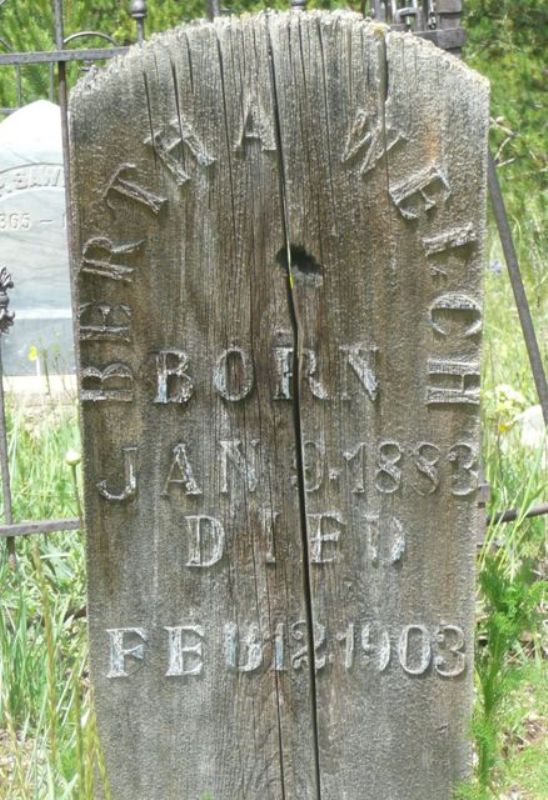
Two of my favorite people to talk about while we explore the vast grounds are the last two: Bertha Welch and Robert "Bob" Lott. I've talked about Bob before, so we'll leave that be. This post is about Bertha.


© Jen Baldwin, Ancestral Journeys
2011-2013

It is a wooden marker, with a significant crack down the middle.

"Bertha Welch, Born Jan 9 1883, Died Feb 12 1903."

Her death was recorded in the local newspaper, telling a sad story of a young bride, neglected and physically abused by her husband, who finally abandoned her while pregnant. She gave birth to a little boy, who at the time of publishing at least, had survived. Bertha, however, passed within days of the delivery, and was buried far from her family in California. A tragic ending to a tragic story.

 I know, without any doubt, that the marker was in its proper place at the head of Bertha's grave on 7 June 2013. I know, without any doubt, that the marker was discovered missing on 14 June 2013, just one week later. Sadly, this was the last remaining wooden marker in Valley Brook Cemetery that you could still read. As far as I am aware, the marker sat undisturbed for 110 years. And now its gone.

It saddens me, to the very depths, that this poor woman; young and alone in death, will now sit unmarked and forgotten by most in her final resting place. I am one that will never forget.


If you have any information on the whereabouts of Bertha Welch's wooden grave marker, please contact the Breckenridge Heritage Alliance. 

970-453-9767
Facebook
info@breckheritage.com

22 May 2013

Breckenridge Memorial Day Commemoration


NEW event at Valley Brook Cemetery on May 27


Breckenridge, CO -- The Town of Breckenridge in collaboration with the Breckenridge Heritage Alliance invite the public to the inaugural Breckenridge Memorial Day Commemoration at Valley Brook Cemetery on Monday, May 27 at 9:00 a.m. to commemorate, acknowledge and memorialize the service and sacrifice of our deceased veterans. The Commemoration will include a keynote speech from Colonel Loren Johnson, the Commander of the 140th Mission Support Group, Colorado Air National Guard, Buckley AFB, an interdenominational service and a wreath-laying.


Headstone of Alonzo Phillips.
© Ancestral Journeys, 2012-2013


The ceremony will be followed by light refreshments. The Breckenridge Heritage Alliance will have an interpretive guide present to answer questions regarding the history of Valley Brook Cemetery. Parking will be available at the Carriage House Learning Center across from the entrance into Valley Brook Cemetery and at the Breckenridge Recreation Center.

Over sixty (60) veterans’ graves have been identified through Valley Brook Cemetery records. Please contact Vanessa Agee at 970-453-3187 x2 to provide further information regarding any veterans who are buried at Valley Brook Cemetery, but whose military service may not be reflected in the cemetery records. Also, volunteers are needed to place flags at each veteran’s grave and to remove flags one month later.

For more information or to volunteer, please call Vanessa Agee at (970) 453-3187 ext 2 or vanessaa@townofbreckenridge.com.

21 April 2013

My first look at the Digital Public Library of America

 How excited were you to explore this new amazing resource?


First glimpse: beautiful.

I was very pleased to open the Digital Public Library of America (or DPLA) on Sunday when I finally had some time to devote to it. The format, layout, color scheme… all very well done and easy to navigate. Thank goodness.

One thing that caught my attention right away was the “Timeline” link in the top menu. I love me a good timeline! Nearly every state I research in, this is a vital tool for me; finding a good online timeline for the area that gives me major events in the history of the area. I tried this first, in my exploration of the new site, and did a search for “Colorado.” The site came back with 17,324 results, beginning in 1827. The results were displayed in a graph, and you click on each bar of the graph to see the events. I chose the year 1859, since that was the year that gold was discovered in Breckenridge, to see if it made the list. What I got was this:


DPLA screenshot 1
Screenshot of "Colorado" search results in the timeline feature. 21 Apr 2013.


Nine images related to “1859” in Colorado. The red link is a title, which then directs you to a citation and brief description of the book. I noticed that you can also view the results of the initial timeline search in list form, or by location on a map. A nice feature.


DPLA screenshot 2
Screenshot of search results for "Colorado" in the timeline, but displayed on the map. 21 Apr 2013


My next exploration was a general search from the homepage. I looked up “Moravian,” since that is a topic I’m working on right now. It brought me 43 results – which is not too bad compared to other sites I have visited in the past week – and a quick scroll through brought me several options to review. I was able to locate exact articles (which then referred me to sites like Internet Archive); census records; images of artwork, historical objects and portraits, to name a few. One feature I particularly liked about the site was the availability to filter the results by the Owning Institution or online Partner, allowing me to chose just what I could access online. Other filtering options include location, subject, date and language. (Also a nice feature, since many Moravian records are in German!) 

First glance, I’m impressed. I see this becoming one of my “go-to” resources, for any major project and plan on using it often.

I recommend following the DPLA on Twitter or Facebook for the latest info and updates. You can find the links on their homepage: 

The Digital Public Library of America


Have you had a chance to explore the site yet? What are your thoughts? I would love to hear about it!


18 March 2013

Wintermute Cross

Actually, a very tragic story. The Wintermute family in Breckenridge was short lived, and though I will spare the details, the basics of it is this: 

They married. They had a daughter. The wife died from childbirth complications. The daughter was sent to be raised by family in California. The husband was depressed and turned to alcohol. He ultimately killed himself at this site, next to his wife's memorial, and is buried along side her. 


04 March 2013

Summit County in the Census’

One thing that happens often in census records is border changes.


summitcnty This could mean that a territory become a state, a state changes size, counties merge or split from each other… even towns increase in size, decrease, or disappear from the record set altogether. Ten years can mean a lot of change in some areas.

One of the things I have had on my list for some time is to look at the towns that existed in the early census collections for Summit County. Technically, the first census here was in 1860, but it is listed under Nebraska Territory, and the records are difficult to find at best. Therefore, I will start with 1870 and move forward.

Summit County was established in 1861 with Colorado statehood. It was one of the original seventeen counties, and that first set of borders included essentially the entire northwest corner of the state. By 1877, the borders we see on the map now existed. Six other counties were eventually carved from this area: Grand, Routt, Eagle, Garfield, Moffat and Rio Blanco. 

The first county seat was Parkville, but the title was quickly transferred to Breckenridge (the general story being that residents of Breckenridge literally stole the county papers in the middle of the night, and hid them until Parkville gave up; they then claimed ownership to the county seat); and the current population resides in the towns of Dillon, Frisco, Breckenridge, Blue River, Copper Mountain, Keystone, Montezuma, Silverthorne and Heeney.


map1


Census Year Census Location
1870 Breckenridge, Montezuma, Not Stated
1880 Breckenridge, Carbonateville, Chihuahua, Clinton Gulch, Decatur, Eagle River, French Gulch, Frisco, Gold Hill, Gold Run Creek, Jack Mountain, Kokomo, Lincoln City, Montezuma, Not Stated, Robinsons Camp, Sheep Mountain, Swan River Valley, Ten Mile
1900 Breckenridge, Dillon, Frisco, Kokomo, Robinson, Precinct 2, 3, 4, 6, 8, 10, 12, 13, 14
1910 Argentine, Breckenridge, Dillon, Frisco, Kokomo, Lakeside, Lincoln,
Montezuma, Robinson, Slate Creek
1920 Breckenridge, Dillon, Lakeside, Montezuma, Slate Creek, Precinct 2, 7, 8
1930 Breckenridge, Dillon, Frisco, Kokomo, Lakeside, Montezuma, Slate Creek, Precinct 8, 9
1940 Breckenridge, Dillon, Frisco, Kokomo, Lakeside, Montezuma, Slate Creek


Interesting, no?


1880 is filled with small gold and silver camps as the area experienced its second rush of mining operations. Some of these areas, like French Gulch, are now considered part of the other towns (French Gulch is an area within the Town of Breckenridge), and some are completely gone.

Both Robinson and Kokomo were left as ghost towns, and eventually the ruins were covered with a reservoir for the Climax Mining Operation on the edge of Summit and Lake Counties. Dillon, although consistent in the census records, has actually moved twice as a community – as in, pick the buildings up and put them somewhere else – and now sits in its (let’s hope!) final location along the shores of the Dillon Reservoir, a major water supply for the front range and City of Denver. Lakeside is another town that was extinguished for water; it is underneath the Green Mountain Reservoir in the northern arm of the county.

If you research one primary area, I would encourage you to do this same comparison. Fairly easy, I just pulled up the Census and Voter Lists search page on Ancestry.com, chose my State, County, and then used the drop down for “Populated Place” to identify the names of the communities. Perhaps not scientific, but it is certainly enough for my purposes.

The immediate benefit of doing this, at least to me, is that I can easily see how the population fluctuated over time. The fewer locations listed in the census generally indicates less communities, so you can see the swells in the main residential areas, at least as far as the Federal Government was concerned. Having a relatively thorough of the area as it is now, and the history behind some of the ghost towns and other communities gives me a broad understanding of how the county developed to be what it is now.

Of course, just like with anything in the genealogy field, it leaves me with more questions. In this case, I am especially interested in the Precincts. What were their boundaries, how were they determined, why did the numbers associated with them change over time? This is something for another post, perhaps…

If you chose to conduct a similar comparison, I would be interested in reading it! Leave me a comment with a link here, or on my Facebook or Twitter accounts. Let’s see what other goodies we can come up with across the country!


25 February 2013

Running Them Through the Sluice Box: Continuing to Filter the Records for Anna & Robert


mining, hydraulic mining, history, Colorado, Breckenridge, genealogy, Rocky Mountains, Hamilton, Sadler, Summit County, Ancestral Journeys
Hydraulic Placer Mining, ca 1935.
Image courtesy of the Denver Public
Library Digital Collections, Denver,
Colorado. 

Have you ever seen how a sluice box works?


The sediment is poured into the top, and water runs over it, like a stream. This allows for the larger, heavier pieces of earth to be retained in the different sections, and the smaller sediment to eventually be washed away. 

This seems to me the next logical step as I search for Anna & Robert Hamilton of Breckenridge, Colorado. They arrived here during a mining boom, and I've been “panning for genealogical gold” for several months.

In past posts, I've explored the 1900 and 1910 U.S. Federal Census records for the family; I've examined my original source, and created some initial questions I wanted to ask. I think it is time to pause, and reassess my timeline and research strategy on the Hamilton’s. We already know quite a bit about the first few years of their marriage, so let’s take a look at all of that, and outline what we don’t know.

Going back to that “original source.” Sandra F. Mather, PhD authored They Weren't All Prostitutes and Gamblers; The Women of Summit County from 1859 to the Turn of the Century. (Summit Historical Society, 2009). In the ending chapter, Dr. Mather introduces us to Anna (Sadler) Hamilton and her husband Robert. Anna kept a journal, and those were examined in order to compose this chapter. From this text, I began to create a timeline of Anna’s life.
  • 2 Sep 1862, birth, Grundy County, Illinois
  • 1870, census, Vienna Township, Grundy County, Illinois
  • 1880, census, Vienna Township, Grundy County, Illinois
  • 1884, teacher’s certificate issued, Grundy County, Illinois
  • 11 Feb 1885, marriage, Grundy County, Illinois to Robert Hamilton
  • 1885, Colorado state census, Summit County, Colorado
  • 13 May 1885, property, purchased a horse in Summit County, Colorado
  • Jul 1885, illness, Breckenridge, Summit County, Colorado
  • 1888, property, owned mining claims in her name, Summit County, Colorado
  • 1904, property, sold mining claims
  • Probably before 1915, death
Although property records can be excellent to utilize, it is not necessary to reside on the land, or in the area, of the property in question. It is possible that Robert purchased this land on her behalf… and a million other “what if’s?” Because I do not have a solid chain of evidence, I am summarizing that I essentially lose Anna’s trail in 1885 when the Colorado State Census was conducted.

However, Robert’s timeline does provide more clues…
  • Cal 1857, birth, Canada
  • 1880, census, Breckenridge, Summit County, Colorado
  • 11 Feb 1885, marriage, Grundy County, Illinois to Anna Sadler
  • 1885, Colorado state census, Summit County, Colorado
  • 1909, residence, Oxford, Nebraska (per newspaper article in Summit County Journal)
  • 1910, property, Denver, Denver County, Colorado
  • 7 Feb 1911, property, Summit County, Colorado (per newspaper article in Summit County Journal. Language of article implies that he resided on his ranch, as well.)
  • 1912, property, Denver, Denver County, Colorado
  • 8 Aug 1913, residence, Weld County, Colorado
  • Abt 1915, residence, Denver, Denver County, Colorado
  • 1916, property, Summit County, Colorado

A couple items to note:

SCJ 24 Jul 1909 p5 Visiting From Nebraska

The article dated 1909 indicates that Mr. Hamilton, his wife and children were visiting Summit County at the time from Oxford, Nebraska, where he operated a highly successful “large stock farm.” This is the only indication I have that the Hamilton’s ever had any children.

Also, the 1911 article indicates that his ranch was “down the blue,” a local term indicating the Blue River. This could have meant north of present day Silverthorne or south of the Town of Breckenridge. If he went north, he still would have been in Summit County for several miles, but going south means either Park or Lake Counties, depending on how far he went. If he went south, it would have made more sense for him to do business in growing Leadville, rather than coming back to Breckenridge. 

Here is what I do not know:
  1. Robert’s actual birth date and location. I have an estimated year based on other record sources, and a country. His father, William, was born in Ormstown, Quebec, in 1830, and arrived in the U.S. in 1881, well after Robert’s birth.
  2. Death dates and locations for both Anna and Robert. Anna’s father, John, was listed in The History of Grundy County, Illinois (Munsell Publishing, Chicago. 1914. Pages 896-897); and this text indicated that Anna had already passed at the time of printing. I have absolutely nothing to give me an idea of when Robert may have died.
  3. Did Robert and Anna have any children? If so, where and when? 
  4. How long were they in Nebraska? Did Robert stay in the cattle industry? He easily could have moved his operation to Colorado and had success.
There appears to be a good deal of information on other member’s of their families… The Sadlers' in Illinois are fairly well documented, as is one of Anna’s brothers that became a politician in Colorado. The Hamilton’s are also represented well. I have been able to track down descendants from both families and inquired if they knew anything of either Anna or Robert. All that has been confirmed was that they existed. Nothing more. 

Next steps.

  • I am going to follow a bit of my own advice, and look into Livestock Brands for both Nebraska and Colorado. There is a chance that I can at least identify Robert’s residences.
  • Vital records from family members in Illinois and Canada may provide clues, as well.
  • Religious sources may be helpful here, also. My first goal will be to determine the Hamilton’s religious preferences while here in Breckenridge. The options in 1885 were fairly limited, and I happen to know that historic records have been preserved fairly well. Even if I cannot pinpoint a particular denomination, it will not take long to examine the available materials, and at the very least, exclude that as an option for more information.


Just a bit more on the parents…

Robert’s father was born in Ormstown. Anna’s father was born in Ormstown. Robert’s mother’s maiden name was SADLER. Anna’s maiden name was SADLER. Both families eventually had connections to Grundy County, Illinois.

Coincidence?

Oh, I don’t think so!


[Sandra F. Mather, PhD., is the author of at least ten books, all discussing the history and geology of Summit County, Colorado. She is a volunteer for both the Summit Historical Society and the Breckenridge Heritage Alliance.]

16 January 2013

Hidden Sources


This past summer, someone asked me where they could find a list of all the Mayor’s that had served for Breckenridge (Summit County, Colorado). At the time, I didn’t know the answer. I put in a few phone calls, but either no one was home at the time, or they never got back to me.

About a week later, I walked into the Breckenridge Town Hall to talk to the records office dealing with our cemetery papers. In the entryway was this plaque:


Breckenridge, Summit County, Colorado, Rocky Mountains, history, genealogy, creative research, sources, Town Hall, plaque, Jen Baldwin, Ancestral Breezes, Ancestral Journeys


How many times had I walked past this? Too many to count. There it was, for all to see, a historical record of our Town Mayors.

What’s the point of this short and simple post? You just never know where your information may come from. Where you might find another clue. At the time I took this photo, I was actively researching three of the men on this list. Not all had been identified in my notes as Mayor. 

By the way, in case you need a transcription of the list, there is one at the Summit County, Colorado Trails to the Past website.


16 December 2012

Panning for Gold in the 1910 Census: Robert & Anna Hamilton

Breckenridge, Colorado, Summit County, Barney Ford, mining, miner, gold, gold panning, Blue River, history, gold rush, 1859, statue, family history, genealogy, Summit Settler, Rocky Mountains
Famous Breckenridge miner, Barney
Ford, depicted in statue with his pan.

Since Breckenridge was built on the Colorado gold rush of 1859, I thought that “panning” for the Hamilton’s in the census records was a good way to describe this search. You see, most of the men who came here to “strike it rich” never did so. They spent hours and hours on their hands and knees, sorting through gravel, silt, and dirt to find that precious piece, that one little nugget that would turn the tide, that would lead them to a world of riches.

And that, my friends, is a really cool analogy for genealogy. It just is.

Aren’t we all digging for that one resource, document, photograph, source that will lead us to the next level in the family chart, the next volume of information on an ancestor?

Here I am, on hands and knees, digging through census records, looking for any hint about Robert and Anna Hamilton. If you have missed the previous posts on this family, please refer back and read through what I have already done. When you’re ready, here is my attempt to find them in the 1910 U.S. Federal Census.

A Brief Review
  • Robert Hamilton (abt 1857, Canada – ?)
  • Anna Jane Sadler (2 Sep 1862, Illinois – prob bef 1914)
  • Married 11 Feb 1885 in Grundy County, Illinois
  • Moved to Breckenridge, Summit County, Colorado by April 1885 when the Colorado State Census was taken.
  • Diaries of Anna (Sadler) Hamilton were found in the Colorado State Archives and place the family in Breckenridge through 1887.
  • 1888: Anna owned mining claims in Breckenridge in her name.
  • 1904: Mining claims were sold.
  • 1909: Breckenridge newspaper lists Robert and Anna Hamilton “and family” as visitors to area, indicating that they were once residents and now living in Oxford, Nebraska as “successful” ranchers.
  • 1910: Deeds in and around the City of Denver, Colorado, held by Robert Hamilton (unconfirmed)
  • 7 Feb 1911: Robert Hamilton “owned Ranch ‘down the Blue"’”, Breckenridge newspaper, a common expression for referring to a particular section of the Blue River in Summit County.
  • 8 Aug 1913: Robert Hamilton purchases residence in Weld County, Colorado.
  • 1916: Last known mention of Robert Hamilton, again in Denver, Colorado (residence)


Let the Searching Begin

Based on this summary timeline, I will begin the 1910 Census search in Denver, Colorado. In 1902, Denver County was created, so this is the first federal census in which the City of Denver is listed as a part of Denver County. Before 1902, it was a part of Arapahoe County. The same action also created Adams County, meaning that the original Arapahoe County was split into three sections. Because this action was still relatively fresh in 1910, I will be evaluating all three counties to ensure a reasonably exhaustive search has been conducted. Once again, I will be using the HeritageQuest Online database, made available through my local library system.

My initial search is for Robert Hamilton, 1910 Census, Colorado. Robert would have been about 53 years of age at the time of this census.
  • Two results were supplied for Denver County, and none for Adams or Arapahoe. Both indicated white males, 45 years of age (too young), one born in Canada and one in Ireland.
  • The man born in Canada is listed with wife Grace, 35 years of age, born Illinois; and three daughters: Ruth, Clarisa and Helen. At ages 14, 9 and 3 respectively, they are all listed as born in Nebraska, which does not jive with the timeline I've already created. The oldest would have been born in 1896, and as far as we know, they were still likely in Breckenridge, or at least Colorado. Certainly, Robert and Anna could have lied about their ages, or just been unaware of their actual birth dates. This Robert Hamilton is listed as a Live Stock dealer. Due to the birth locations of both Robert and Grace listed in this census, and the stock/cattle association with his occupation, this entry will be kept on the *maybe* list.
  • The Irish born Robert Hamilton is listed with his wife, Martha, and three daughters: Gladys, Evaline and Winifred, all born in Colorado. He is listed as an Auditor in an office.
Knowing there are many ways to abbreviate “Robert”, the next step is to conduct a search with a broader scope for his given name. I tried all the different formats of Robert I could think of. Zilch.

An “advanced search” was then conducted, looking for “Hamilton” in just Denver County. 112 Results were supplied, which were then sorted by age. Looking for anything similar to Robert and Anna in their perspective age ranges (53 and 48); once again, the search came up empty. I conducted the same process for both Adams and Arapahoe Counties. Combined, those counties were able to produce 2 results. Guess what? No matches.

Moving on… Anna’s Turn

Beginning with the simple search: Anna Hamilton, 1910 Census, Colorado: two results, one at 40 years of age, born in Germany; and the second at 35 years, born in Kansas. The 40 year old woman was a hotel keeper, listed as head of household, with two children, but only one living with her, with a last name of Schafer. From what I know of Anna, this situation seems unlikely. The younger is listed on a page that is very difficult to read, but I was able to make out “widowed”, and her parents were listed as being born in Kansas. Too far of a stretch from the Anna I’m looking for.

A quick look at all of those in Colorado with the last name of Sadler (Anna's maiden name) resulted in only 12 results, none of which were anything close to Anna, Robert, or any potential children.

Knowing that her father, John Sadler, lived until 1914, I also identified his household in the 1910 Census, in Grundy County, Illinois. Just to be safe. He was residing in Vienna, widowed, with his son Harry and family.  A search in this area for Anna Hamilton, Anna Sadler, Robert Hamilton, all proved to be fruitless. I also searched for Robert Hamilton, between the ages of 51 – 59, for the entire state of Illinois. Again, nothing.

I need to eliminate Grundy County all together, so my next attempt was "Anna" (no last name at all), 1910 Census, Illinois. I searched Grundy County first, with 46 results, again, sorted by age. One entry popped out at me, that of Anna Handlon, age 47, born Illinois. It's a stretch from Hamilton, but hey, it's about as close as I've gotten so far. Taking a look at the details shows this woman as a widow, with no children, and her parents being born in Germany. No go.

In order to limit the possibilities, I added Anna's age range to the given name search: 41-50. From here, I conducted a county-by-county exam of all the possibilities that came back. I got a little stirred up when I found a Anna HANILTON in St. Clair County. Was it her? Of course not.

(How many ways in one blog post can I find to say, “I got nothin’?”)

Back to the Mountains

Because of the connection to property in Summit County in 1911, a search of that area was required.
Summit Country provided two Hamilton’s: Harry T (29 years) and John S (31 years). Neither are quite young enough to be Anna and Robert’s children. Harry’s mother is listed with him, by the name of Mary, born in Pennsylvania. John is identified as a boarder in a Robinson household (the town of Robinson no longer exists), and has an occupation of electrician in a mine.

And Now? The Plains.

Nebraska. My last hope.

The newspaper account we have of the families visit to Summit County was printed in the Summit County Journal (Breckenridge) on Jul 24, 1909, on page 5.

Summit County Journal, 1909, Summit County, Colorado, Breckenridge, news, Hamilton, Oxford, Nebraska, stock, farm, family history, genealogy, research, Rocky Mountains


A town in Furnas County, Nebraska, Oxford dates back to December of 1878 when the first settler’s were granted the “final receipts” for land on the eastern edge of the county. (General History of Oxford, Nebraska. Oxford, Nebraska official website. www.oxfordnebraska.com/history. Accessed 12 Dec 2012.)
Trying to leave my search as broad as possible, I ran “Hamilton” in 1910 Nebraska. Furnas County had four people listed: Charles, Eames, Edward and Sadie. None were close in age to either Robert or Anna, nor were their birth locations similar. Again.

*sigh*

I adapted the search for “Robert Hamilton” in Nebraska and seven counties were listed. In the 1900 Census, I found a Robert Hamilton and his wife, Clara, living in Douglas County, and they are still there in 1910. This time, I can see that his wife was born in Wisconsin, and her parents in New York, so given the geography, I am officially omitting this family as an option.

Once again, nothing else came close. My original looks at Oxford indicated that the town crosses county lines, into Harlan County. A specific look at records from that county resulted in young men, Charley and John. No go.

The Geography

It seems to me that they traveled a fairly distinct line across the states. From southern Illinois, to south central Nebraska and west to central Colorado. The went back and forth a bit, over time, but they seemed to remain in that general corridor.


Breckenridge, CO to Vienna, IL - Google Maps
Created using Google Maps. Ancestral Journeys, 2012.

Since it appears that Anna died around 1914 sometime, the next piece of my search will have to stray away from census records. Since Robert Hamilton has proven to be relatively common, and since I do not know any of the children’s names, I believe there to be better ways to continue this journey through the middle of our country.

Where in the US are the Hamilton’s?

But then, Robert was born in Canada. So perhaps they are not in the U.S. at all... 


05 December 2012

Incredible Stories of Incredible Women

I'm a pretty lucky gal. I have a lovely family, a nice home, a good life, really. I enjoy what I do, and I'm challenged by thoughts of what I could do. I have mentors in my field, I have people in my past that inspire me. And, I have people that I'm just getting to know, just reading their stories. Incredible, awe inspiring, jaw dropping stories.

If you are at all interested in the life of women in the Colorado Rockies from the Gold Rush (1859) through the turn of the century, here are a couple must read's:

  • The Magnificent Mountain Women by Janet Robertson (University of Nebraska Press, 1990.)
  • They Weren't All Prostitutes and Gamblers by Sandra F. Mather, PhD. (Summit Historical Society, 2009.)
  • Doc Susie by Virginia Cornell. (Manifest Publications, 1991.)
  • Women As Tall As Our Mountains, Collected Short Stories. (P.E.O. Chapter F.U. 1976.)

Colorado, history, biographies, women's history, short stories, Summit County, Rocky Mountains, adventure
Four great reads.


We all know life was hard for our ancestors'. This very special collection of women makes that abundantly clear. This is by no means a comprehensive list, however, it is a good start to understanding the difficulties faced by the first female pioneers of this difficult country.


29 November 2012

Robert & Anna Hamilton: 1900 Census Search, not quite done!

And, we're back.

Robert & Anna Hamilton just will not let my brain rest, so I am doing this post on my search for them sooner than I planned. You can read all about them in two previous posts; dated 29 July 2012 and 25 Nov 2012.  They create an intriguing mystery, and I am hoping to solve it.

A couple of suggestions were made after my most recent post regarding the search I conducted for the family in the 1900 U.S. Census. I thought before moving on to 1910, it would be wise to examine at least one of those.

Grundy County, IL.
Source: Wikipedia.

At one point, I theorized that Anna, and her family, may have gone back to Illinois either to live or for extended visits. We know from two of Anna's journals held with the Colorado State Archives, that she was generally unhappy living in Breckenridge, and "pined" for her family and friends back home. A reader, Deborah Andrew, thought perhaps that she may be listed in the census with her family, possibly even under her maiden name of Sadler.

Anna was born Anna Jane Sadler, on 2 Sep 1862 in Illinois, probably Grundy County. She and Robert married on 11 Feb 1885, also in Grundy County. Before this, we have no record of Robert ever living in Illinois, and because of research done on the families, it is probable that the families were already connected by marriage, or at the very least, friendly with each other, before the nuptials. Jane's parents were John Sadler and Matilda Hamilton. They had been in Illinois since at least 1862 when Anna was born, and I have been able to pinpoint that both John  and Matilda were born in Ormstown, Quebec.

Being the oldest of six, Anna was closest in age to her brother, George Walsh Sadler, and he also resided and died in Colorado. Two others I have at least an approximate death date for, but two are completely unaccounted for, so it would appear that I have some cluster genealogy to do.

In the meantime, here is what I could find on the Sadler's in the 1900 U.S. Census, focusing on Grundy County, Illinois:


  • In the Vienna Township, John Sadler, aged 62 years, born Canada. He is listed with his wife Matilda, and just one child, Harry (the youngest). He is a farmer, and both he and Matilda reported their parents being born in Ireland. 
  • Also in Grundy County is William Sadler, residing in Felix Township. He is 51 years, listed with wife Kate, and was also born in Canada, with Irish lineage. Although I do not have a familial connection to this man in the Sadler/Hamilton family I'm searching, he is one that I need to remember, because that could easily be the case. Per Google Maps, the two communities are less than 24 miles apart. Could be a coincidence, but it certainly could not be, also! 


Headstone of George W. Sadler and his wife, Lillian.
Source: www.findagrave.com
There are several other counties in the 1900 Illinois Census that list Sadler residents.

Although some of the results were interesting, including a listing from the insane asylum, none of them appeared to be Anna or her possible children. Or her siblings, for that matter.

I would be interested to see what other resources researcher's use for Illinois, or specifically Grundy County, as it appears the family was there for some time.

25 November 2012

Looking for Robert & Anna Hamilton in the 1900 Census

My quest for the Hamilton family, and what happened to them after they left Breckenridge, Colorado around the turn of the century has certainly not ended: not even close. I have left them alone for a few weeks, and am now seeking the family in the 1900 United States Federal Census.


What Do I Already Know?

1885 Colorado State Census
Robert Hamilton married Anna Jane Sadler on 11 Feb 1885 in Grundy County, Illinois. By June of 1885 when the state census was taken in Colorado, they were residing in Breckenridge, Summit County. They lived in that town at least until 1888, as we can track them through business and newspaper mentions.

The family can be found again in 1910, now living in Denver, Colorado. They appear to have resided for a time in Oxford, Nebraska, which sits on the county line of Furnus and Harlan Counties. In 1911, Robert Hamilton again owns land in Summit County, a ranch along the Blue River. He travels back and forth in successful business ventures for at least the next couple of years.  Anna appears to have died by or in the year 1914, according to a biography written about her father, which was published in Illinois.

Robert was born in Canada about 1857, and Anna in Illinois on 2 September 1862. Their families appear to have been connected by marriage in previous generations.

They were reported by the local newspaper in Breckenridge to have had children, but the number, sex, and names of those children were left out.

Anna had at least one brother who also resided in Colorado, George W. Sadler resided in Divide, of El Paso County. He was elected to a local office in Nov of 1899, so he had to have been there for at least a few months, if not a year or more, to gain the friendship of enough voters. He married Lillian T. Unknown and together they had at least three children.

The Search

I am starting in the HeritageQuest Online database, accessible through my local library system, and searching a combination of the following parameters to locate the family in the 1900 Census.
Robert: would be about 43 years of age, born Canada.
Anna: 38 years old, born Illinois.
Assuming the children were born sometime in the first five years of marriage  and I know there were at least two, they would be at oldest 15 years, and born in Colorado or Nebraska.

Previous, more detailed searches have not been able to determine any matches, so I am leaving this process vague intentionally, hoping to find even a sliver of hope.

I was given 225 results to scroll through, using just "Hamilton" in the name fields, 1900 Census in Colorado. Nearly every county is listed.

  • Summit County: three results, none match. 
  • El Paso County: no matching results, out of 17 results.
  • Arapahoe County (where Denver would be located at this time): 63 results, no matches.
Having eliminated the obvious options, I am left to simply go county by county down the list. The results were... nothing! Not a single even potential candidate for either Robert or Anna. 

Moving on to Nebraska... Neither Furnas nor Harlan Counties were able to produce the correct Hamilton's. Once again, I am left to search county by county.  

Only one possibility was found in Nebraska: Robert Hamilton, age 42, born Canada, found in Douglas County, in Omaha. He is of the right age and race. The image is difficult to read at best, so I was unable to determine from this source if he was listed with family. However, there were no Anna Hamilton's that came up for this area, and if she had been on the census page with him, then she would have been listed in the results. 

Once again relocating the search, this time to Illinois. I know from her diaries that Anna really never liked living in Colorado, and especially in Breckenridge, and she pined for her friends and family back home. It's certainly possible that they went back there, especially since Robert also had ties to Grundy County.  

My search, once again, comes up empty. Nothing.

Breckenridge, Colorado.
Copyright Jen Baldwin, Ancestral Journeys, 2012

Broadening my scope just one more time, I attempted a more detailed search for Robert Hamilton, born in Canada, between the ages of 41-50, all states, for the 1900 Census. Six states came up with a possible match: Nebraska (see above), Massachusetts, Michigan, Wisconsin, North Dakota, New York. None of them had a wife named Anna, or seemed to match any of the other information I currently have access to.  A similar search was conducted on Anna Hamilton, and three possibilities were found: two of which were already widowed, and we know that Robert outlived Anna. The third was listed as married, but her husband was not identified in the same census record. She was found in Campaign County, Illinois, with three daughters, all born in Illinois. However, those daughters list their parents place of birth as Illinois for both the mother and the father, so already, there is discrepancy. However, it is a valid candidate. 

A search on Ancestry.com for the Nebraska result of Robert Hamilton lists his spouse as Clara, and she is the wrong age (not even in the ball park).

What happened to the Hamilton family?  Obviously, there is more searching to do... I have records on Robert from another researcher that date from 1910, 1911, 1912 and 1916, all from Colorado. But, the 1910 and 1920 census records have yet to be identified. Nothing yet has been located on Anna's death or burial. And Robert's death? Also, in the "yet to be determined" category.

More to come, certainly, on this mysterious family. 

17 November 2012

Did You Hit the Ad's?

One of the joys I find in genealogical research is digging through historic newspapers. It's fun! Yes, we can gain a great deal of insight and real life experiences of our ancestors from these incredible resources, but there is more. Scanning the headlines, reading the quick notices, the short articles; all of that comes together to create an astonishing experience  placing yourself in that moment in time.

Breckenridge, Colorado, Summit County Journal, 1917, Gough, advertisement, newspaper, historic document, genealogy, family history, ancestry, historic newspaper, research
Summit County Journal, Breckenridge, Colorado.
1 Sep 1917, Page 8.

One thing I make sure to look for in newspaper searches is the advertisements. Have you stopped to investigate these as genealogy source? Just this advertisement for the Rogers Furniture & Undertaking Company from Breckenridge, Colorado tells you so much information: location, what they did, note the Proprietress is Mrs. J. GOUGH, and the year the business began. Knowing what I do about Breckenridge history, the date given of 1880 makes sense; the town was created in 1859 and by 1880, it was thriving. Now I know where else to look: 1880 Federal Census, 1885 Colorado State Census, cemetery records (because they acted as Undertakers and Funeral Directors), etc.

Consider the other aspects as well. As a business, they were doing well enough to afford a reasonably sized advertisement in the local paper, but not well enough to get it on the first page (it was found on page 8). In 1917, Mrs. Gough felt confident enough in her role to list herself as the "manager"; or was it that she felt a feminine touch was necessary in this particular industry?

Try a series of dates to learn more!  We can use Robert "Bob" Lott, former resident of Breckenridge, as a fantastic example. When he passed away in 1913, his friends in the community gathered to give him a proper headstone, in the "Pauper Section" of Valley Brook Cemetery. His headstone was so fascinating, it absolutely demanded more attention:

Copyright Jen Baldwin, Ancestral Journeys, 2011.

Although there is little mention of Mr. Lott in standard newspaper articles of the time period, and even less in community historical documents, there are a lot of ad's. I have learned that he went from catering - delivering meals to your home - to owning his own restaurant, partnering with at least three other men in town of varying degrees of status and luck, finally moving back to his original spot in town, where he ran a successful steak house for several years. He was the only African American living in Summit County, Colorado at the time of his death (per his obituary). Just from the newspaper pieces alone, I have been able to establish a decent timeline of his adult life, leading to further investigation. I hope to someday have his life story; where he came from, and how he ended up in the mountains of Colorado. His is one story of our community that deserves to be remembered, and its up to me, since he left no descendants. 


I have to wonder: Oysters or "Rocky Mountain Oysters"?
Summit County Journal, Breckenridge, Colorado.
5 Jan 1907, Page 5.


Have you gained invaluable data from newspaper articles? Do you have one to share? Please let me know! Leave a comment or a link, and I'll be sure to connect with you.