Showing posts with label tombstones. Show all posts

17 June 2013

We Lost One

During the summer months, I am pleased to serve as a tour guide for the Breckenridge Heritage Alliance. We offer historical tours of town, mining sites, museums, and my personal favorite and area of expertise, the Valley Brook Cemetery.

From the day we moved here, I have loved Valley Brook. It is peaceful, beautiful and at the same time, alive with history and stories of our past. Here you will find many of the Breckenridge "great's", like Edwin Carter, Robert Foote, and the Detweiler family. You will find hundreds, however, whose stories have yet to be told. I am working to change that; trying to tell their stories, one person at a time. You have seen some of those stories here, on this blog.

This past weekend I was scheduled to conduct the Tombstone Tales at Twilight Tour on both Friday and Sunday. I had been in the cemetery more than once in the past few days, and had already conducted the tour a couple of times this spring, so I was more than prepared for the anticipated busy weekend. Breckenridge celebrated our "Kingdom Days" event over Saturday and Sunday, and our tours are typically at capacity while residents and tourists alike submerge themselves in the history of our community.

Two of my favorite people to talk about while we explore the vast grounds are the last two: Bertha Welch and Robert "Bob" Lott. I've talked about Bob before, so we'll leave that be. This post is about Bertha.


© Jen Baldwin, Ancestral Journeys
2011-2013

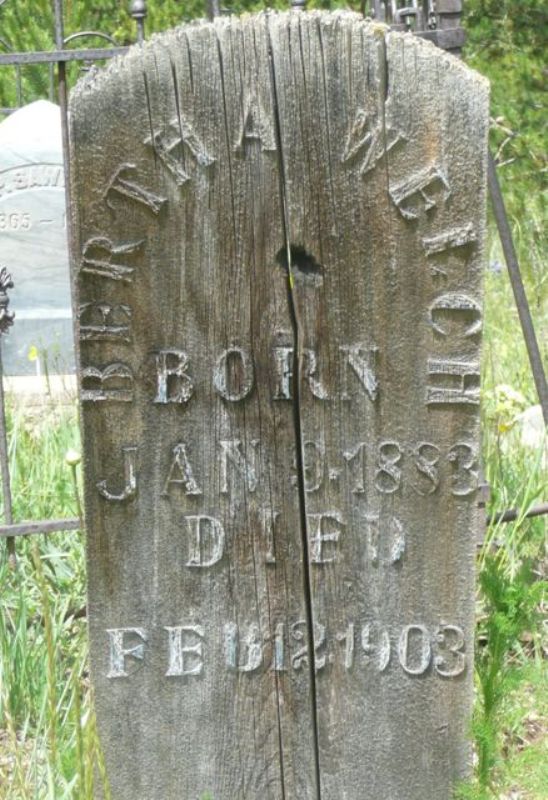
It is a wooden marker, with a significant crack down the middle.

"Bertha Welch, Born Jan 9 1883, Died Feb 12 1903."

Her death was recorded in the local newspaper, telling a sad story of a young bride, neglected and physically abused by her husband, who finally abandoned her while pregnant. She gave birth to a little boy, who at the time of publishing at least, had survived. Bertha, however, passed within days of the delivery, and was buried far from her family in California. A tragic ending to a tragic story.

 I know, without any doubt, that the marker was in its proper place at the head of Bertha's grave on 7 June 2013. I know, without any doubt, that the marker was discovered missing on 14 June 2013, just one week later. Sadly, this was the last remaining wooden marker in Valley Brook Cemetery that you could still read. As far as I am aware, the marker sat undisturbed for 110 years. And now its gone.

It saddens me, to the very depths, that this poor woman; young and alone in death, will now sit unmarked and forgotten by most in her final resting place. I am one that will never forget.


If you have any information on the whereabouts of Bertha Welch's wooden grave marker, please contact the Breckenridge Heritage Alliance. 

970-453-9767
Facebook
info@breckheritage.com

25 March 2012

The Adams Family

Buried together in a small corner of the Valley Brook Cemetery in Breckenridge, Colorado, sits the Adams Family: Josie, Marie Therese (mother), Paul G., and Philip P., (father). Little Josie caught my interest first, as early deaths are wont to do, and tucked on my maternal heart strings. Today I got the chance to take a look at her family in a more structured and intentional way. 

Adams Family Plot


Josie Adams did not survive for long in the sometimes extreme environment of Summit County, Colorado. Born in September, she lived just over a year.


According to the 1900 and 1910 census records for Summit County, Philip was born in Germany, and arrived in the United States in 1880. The State of Colorado Historical Records Index Search (http://www.colorado.gov) revealed nothing, neither did the Bureau of Land Management General Land Office Records database (http://www.glorecords.blm.gov/default.aspx). Since both of these are initial search resources for me, I had to dig a little deeper. The 1920 census reveals that Philip became a Naturalized Citizen in 1894, but does not mention the still living Marie in the same household, though it does say that Philip is still married.


Census records tell me that Marie was born in Wisconsin. The 1900 Federal Census provides a marriage date of 1883, and I was able to locate a marriage record in the BYU Idaho Special Collections & Family History (http://abish.byui.edu) system for Philip Adams of Breckenridge and Threasa KLANKA of Breckenridge, 24 May 1884 (Western States Marriage Record Index, ID 349647, Vol. A, Page 21). The marriage took place in Breckenridge, so this is more than likely the correct Philip and Therese.  Using the spelling of her first name provided by the headstone, rather than the alternate on the marriage index, searching for Therese Klanka born in Wisconsin in 1859 on FamilySearch (www.familysearch.org) gives me the following result:
1870 Federal Census, Therese KLENKE, born 1859, Wisconsin. Daughter of Anton and Dore, sister to Herman and Carl. Residing in the Town of Herman, Sheboygan County, about 65 miles north of Wisconsin, just inland from the shore of Lake Michigan.

From what I have already collected, the Adams also had children Dora, Agnes and Clara, all born in Colorado. So what happened to them? Since they all survived at least long enough to be recorded in the 1900 Census, they probably married and moved on with their new families.

Paul G. Adams, born Sept. 13, 1885, is also buried in Valley Brook next to his parents and baby sister. The General Land Office Records database (see above link) tells us that he obtained property in Baca County, Colorado in 1920; but the 1930 census has him back in Breckenridge. Where will he be in 1940, I wonder? Guess I still have a few days before that information becomes available... (see the 1940 U.S. Census Project for more information!)

If I had the inclination and time, I would order Philip's naturalization papers to see what else I could learn. However, for the purpose of this summary, I believe I have said enough. Please note all of the above resources were accessed on 25 Mar 2012, and a FindAGrave memorial has been created for Philip Adams (www.findagrave.com, memorial # 87354918); I would imagine the rest of the headstones will be added to the site before the end of the day. The research done for the purpose of this blog was also conducted and completed on 25 Mar 2012, and is stored in the personal files of Jen Baldwin, Ancestral Journeys, author. A full genealogical report will be posted on the Summit County Trails to the Past website in the near future (http://www.rootsweb.ancestry.com/~cosummtp/).

22 March 2012

Wordless Wednesday: William & Estella Brown

 Wordless? Ha! Just not my style...

William James Brown was the third son of William Warner Brown and Emma Anderson (Andersson?) of Orting, Washington. Born 9 Feb 1921, he married Stella Lindsley on 1 Dec 1942. Uncle Bill was a Merchant Marine in WWII, before signing up he worked on the ALCAN (or Alaskan-Canadian Highway) with the CCC. He also served in the Army Air Corp, never going abroad. After his service was over, he worked in a cardboard manufacturing plant in Sumner, Washington, and remained there until retirement.


William J. Brown


Bill & Stella


Estella Lindsley may have been Native American, possibly in the Puyallup, Washington area.  We know she had a sister named Ester, and one member of the family remembers seeing more in the family.

They are both buried in the Orting Cemetery, Orting, Washington.


20 March 2012

Youth In Cemetery

Leadville Girl Scouts
 Are kids, our next generation, interested in genealogy?

Well, maybe not. But I think we can do something about that. For the past year, I have been working with a local Girl Scout Troop in Leadville, Colorado. I have three nieces in the group, and my sister is one of the leaders, so it was a pretty easy and natural thing for me to be involved, and to be excited about the chance to pass my passion on to someone else. Someone young.

Author and family with the
Cose family marker.
We started last summer by taking the girls to the Evergreen Cemetery in Leadville. We had a local history buff tour us through the headstones, and she was wonderful and full of information. She showed them different kinds of graves, different areas of the cemetery (i.e. The Elks, I.O.O.F.), and told a lot of entertaining stories. About half way through though, she lost her audience. The girls just stopped listening. They wanted to either be entertained or entertain themselves.

After the "official" tour, I stepped in. I talked to the group about headstone rubbings, and we practiced on a few newer graves. They had over sized paper and a crayon. They were pretty happy for about ten minutes. Most of the kids started to filter home at this point, and that was okay. They were done.

I had something else completely in mind for my nieces however. There was a headstone I needed to find. At the time, they were 7 and 9 years, so I told them we were going on a scavenger hunt. That perked them right up! I gave them a general area of the cemetery, which we found using the map I brought along, and set them loose. They were excited because they were in charge, and they had a goal. We'd been at the cemetery for over two hours at this point, and no other goal had been established for the group. I think that was mistake #1.

We did find who I was looking for, even though I ended up actually finding her, and not the girls. Catherine J. (Daniels) Cose, 1858-1941. She was the sister of my 2nd great aunt, and I had just recently made the connection to the Leadville area.  I could not believe how excited they were to find her and her family! To them, it was real. It wasn't just names on paper with dates and random stories about a person they'll never meet, it was there, in front of them. For the first time, we had evidence that someone else in our family had lived in Leadville; we had always thought that my sister's family were the first to be in the area. And here was someone that was in their town. 


The question is, "is the next generation interested in genealogy"? Yes, I think they are. You just have to make it real. Leading the group through the genealogy project this year, I started bringing a picture of the same guy every time; Oscar F. Brown, my 2nd great grandfather. Every time I met with them, we would start with holding him up, and saying "hello" to Oscar. We would repeat what we knew about him...  he lived in Nebraska, he fought in the Civil War... they were engaged. That brings them to being interested about the topic of the day, whether its different kinds of records, geography, or family crests.

Jennifer Holik, genealogist and author, will be releasing Branching Out: Genealogy for 1st-3rd Grade Students very soon. I'm excited. Very excited. You can see her other publications and blog at http://www.generationsbiz.com/. You should also check out her blog post on Archives.com, "Connecting Children With Their Past" for great tips on getting started: http://www.archives.com/experts/holik-urban-jennifer/kids-genealogy.html.

28 February 2012

Tombstone Tuesday: Eilert & Anna Heerten

Eilert and Anna Heerten are buried in the Ainsworth Cemetery, Ainsworth, Brown County, Nebraska.

Eilert was born in Hanover, Germany, 21 Jan 1846 or 1847, and in 1869 he came to the United States as a stowaway on board the vessel "New York", which sailed out of Bremen. Son of Silas Heerten, who remained in Germany, we know that he had at least one brother remaining in that country at the time of his death in 1929.  Originally settling in Pettersburg, Illinois, he also lived in Woodford and Mason counties, and could be found in Illinois at least through 1890.  On 7 Dec 1874, he married Amke "Anna" Dirks Rademacher in Tazewell County, Illinois, the daughter of Dirk Harms Rademacher and Aaltje Frerichs Buhr. She was born 30 Oct 18 in Zwischenbergen, Hanover, Germany, and arrived through Baltimore on 28 Oct 1867. By 1868, the family had settled in Pettersburg, Illionis.

In the 1900 census, he was listed as a farmer in Keya Paha County, Nebraska, and that is where he remained. His descendants can now boast a long line of residency in that county.  He appears in Keya Paha County as early as 1885. Having moved to Nebraska with three children, they spent their first winter in a 12x14 sod house shared with two other families: the Olaf Nelson family and the Frank Dixon family. Over the course of the summer months, three frame houses were built, and each family claimed their homestead.

Well known in the community, and seemingly hard working farmers, the Heerten's were the first to purchase a steam engine and threshing machine in the area, from J.I. Case Company. They would eventually hire son John as a traveling repair man, and he gained quite a reputation as an unmarried good looking fellow. He did eventually marry at the age of 41 to Emma Anna Koehnken of Natrona, Illinois. On 18 April 1913, a dark grey horse was foaled and named "Patsy." This animal is listed in The National Register of French Draft Horses (#26156), and was owned by Eilert Heerten of Norden, Nebraska.

Eilert and Anna had seven children through their married life; John, Dick, Annie, Herman, Frank, Edward and Bessie, most of which remained in Nebraska. Ed was a veteran of WWI.

Eilert died in 1929 and Anna in 1928, her death coming after an extended illness. The family oral history tells us they had a good and happy marriage, and their children and grandchildren remembered them fondly.

27 February 2012

Cemetery Tool Kit


During the long winter's in the Rocky Mountains, I get a lot of time to think. One thing that is in continuous development and evolution is my cemetery tool kit, and that got me wondering... what does the rest of the world take with them to a cemetery?

Here's a look at mine.

Right now, I use a simple canvas bag to carry all this in, but I'm looking at investing in a canvas tool bag instead: bigger, more pockets, better organization, and sturdy as hell. Something along the lines of the Great Neck 21042 Essentials Around the House tool bag. I considered a back pack, but then I'm constantly taking it on and off, and that would be troublesome. This bag has great features, and I like the idea that I can safely stash things like my cell in easy to reach pockets. Another reason I like this model is that it's designed for women; it's smaller and lighter than other tool bags I have seen, and the handles are narrow, making it easier for smaller hands. (You can find the Great Neck Essentials bag on Amazon.com.)

Inside my bag, you will always find:


  1. Pen and Paper.
  2. Camera with extra battery and neck strap.
  3. Gardening gloves.
  4. Garden shears and small gardening shovel (for those hard to remove weeds and overgrown graves).
  5. Garbage bags. I like to remove litter as I go through the site.
  6. Small spray bottle of water.
  7. If available, a map of the cemetery and/or plot map.
  8. List of any specific names I might be looking for.
  9. Snack.
  10. Drinking water.
In my car, you will always find a good cemetery conservation guide book (discussed in previous posts), another snack, and an extra layer of clothes, including fresh socks. You just never know what the weather is going to do around here (my local cemetery sits at 9,600 feet), and those are items that are generally in the car year round anyway. In the summer months, I throw in my good rain gear, as we get a decent thunderstorm nearly every day. 


Our cemetery season, as I like to think of summer, is short here. I might be able to get through the snow pack in May, but its typically mid to late June before I can really spend any significant time out there. Snow starts falling again in late September - mid-October. Most years, you will find me exploring cemeteries as late as November 1, before the snow really begins to accumulate and headstones become hidden under a soft white blanket once again. 


So, I'm curious. What's in your cemetery tool kit? I try to keep it light, but I certainly don't want to miss anything good. Comments are invited. 

Thanks for reading... 
jen

25 February 2012

Headstones

There are numerous resources available on the iconology of headstones, and even more websites. I prefer to use the tried and true... here are a couple good ones:

Stories Told In Stone: Cemetery Iconology by Gaylord Cooper (MOTES Publisher, 2009)
Stories in Stone: A Field Guide to Cemetery Symbolism and Iconography. Keister, Douglas (photographer) (Gibbs Smith Publisher, 2004).

In my experience, you shouldn't be surprised at anything you see in a cemetery. Headstones are often designed to reflect the life of the deceased, or the emotions of those in the family left behind. Here are some typical and not so typical examples I have come across.

The lamb is typical of a child's grave.

Standard and simple flat headstone 
 
One example of a photo headstone.

Full grave marked by a headstone and a toe stone.

Ornate and large marker. This example is about 6 feet tall.

The rock. Often used in mountainous environments.

Another rock example.

Engraved picture, personalizing the marker.
This one with a snowboarder image.


The gates typically represent the entrance to heaven.
Military marker.
Older military marker.

Religious symbolism.


Heart shape on pedestal.

This is much more unique, designed to look
like a BLM marker. 

Top of BLM style marker.


One plaque, three names, with a rock to represent each individual. 


Headstone and "assumed" toe stones,
with a large gap in between and a drainage ditch of sorts.
The grave does not appear to extend from one side to the other. 
Another rock, but this one is quite large.
Approx. 4 feet across, and 2 feet high.

One of the few wooden markers I have seen with  surviving inscription.
A bench near a family plot, without engraving.
Intended just for sitting and remembering -
an invitation to those left behind.


Engraved bench memorial.


(All of the photos were taken at Valley Brook Cemetery, Breckenridge, Summit, Colorado. Photographer: Jen Baldwin. Copyright 2011, published.)

Cemeteries: Valley Brook Cemetery

Valley Brook Cemetery is located in Summit County, Colorado, in the town of Breckenridge. It lies not far from the main downtown area, across from a daycare. It's truly a beautiful location, set on a hill with tall trees and gorgeous wildflowers during the summer months.

One of the unique features was the trend of putting ornate gates and fences around grave sites and family plots during the Victorian Era.

Last summer I spent several hours photo documenting the gravestones, and I estimate to be about 75% finished with the primary cemetery. The Breckenridge Masonic Cemetery is immediately adjacent, and I plan to finish Valley Brook and the Masonic section this coming summer. It is truly a peaceful and inspiring place, and one of my favorite locations in Breckenridge.